
February
Almanac entry #2: Little miracles, returning to dust, and the American Robin

If January felt like it lasted for years, February has flown by in a whirlwind of mild weather and Valentine’s parties. The birds are singing in the mornings again, and people smile at each other as they take evening walks in the growing sunlight hours. There is hope for the world. If this is Fools’ Spring, I’m the biggest fool there’s ever been.
Everything still seems slow in the natural world, but there are always the constants, and I find myself grateful for their comforting presence. For many of us in North America, there is always the American Robin.
Robins are often heralded (mostly by old ladies) as one of the first signs of spring, which has never made much sense to me. The robins never leave for the winter! They’re here the whole time, you just haven’t been paying attention, Linda! But that isn’t entirely fair. Actually, we don’t know much at all about robins’ migratory patterns, despite their familiarity. And the fact that it’s literally in the name — Turdus migratorius.
In parts of Canada, robins do migrate south for the winter. But for the rest of us in the lower 48, we are the south. The robin numbers in many states increase each winter as Canadian and Alaskan birds flee the harshest cold to hang out with resident robins. They’re able to spend their winters in the Midwest and northern US because they change their diet. If they stuck to their whole shtick of getting up early and eating worms, they wouldn’t last very long at all. Instead, they switch from invertebrates to fruit, such as junipers and crabapples. As far as we can tell, they follow the food — once they’ve cleaned out the fruit in one area, they move in numbers to another one. As a result, you might not see robins in your backyard during the winter, unless you have winter-fruiting trees or shrubs. But when you find one robin, you’ll likely find a whole bunch.
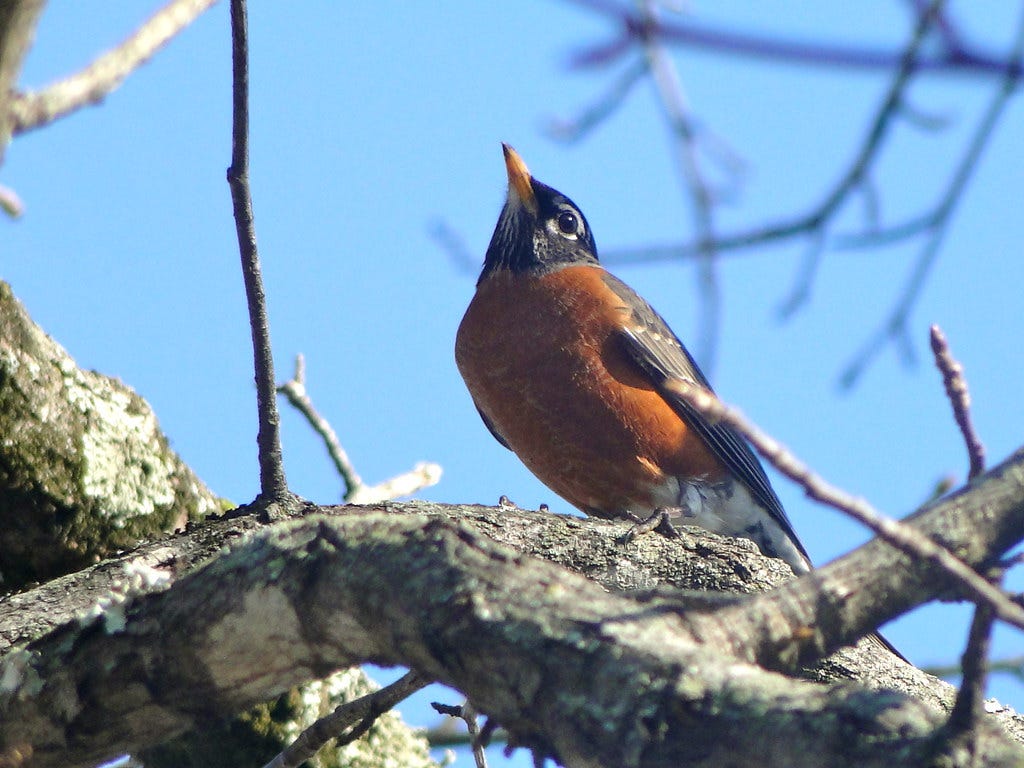
This month, I’ve seen more robins than I have in maybe my whole life up to this point. Walking through the park on one mild Monday evening, I looked up to see the sky full of chirping black spots. Hundreds of robins, gathering together to roost for the night. Instead of dispersing among backyards and paying visits to old ladies, they disappeared into the forest to sleep in a huge flock. I wanted to run after them, to discover their chosen resting place. I imagined what it might be like to fall asleep on the leaf litter beneath them, and wake up to a cloud of red and white and charcoal gray lifting from the trees above me. But I suppose even the most familiar birds are strangers to me, and will always hold their own mysteries. When that “first” robin of spring appears on my windowsill, I will have to accept that it has been part of movements and gatherings and comings and goings that I will never understand. The fact that it is here at all — through snowstorms, predators, and a wildly fluctuating climate — is a miracle.
A strange thought, that something as commonplace as a robin can be a miracle of survival, genetics, or anything at all. I guess it depends on your definition of a miracle. If all we are looking for are the grand, sweeping miracles of myth and legend, then a little bird hardly counts. If we look at the real nature of things, we realize the whole world is knit with miraculous threads. If the whole world is made of miracles, is anything truly miraculous? Is a miracle any less miraculous just because we don’t notice it, because it happens every day? Trees falling in forests or robins returning to old ladies’ backyards — necessary, miraculous facts of life.
On Ash Wednesday, I sat in a church pew, tired and hungry after a day of fasting, and resisted the instinctual urge to wipe the ashes off my forehead. I am no stranger to dirt — I work with it every day and often come home stained with it, all over my clothes and under my fingernails. It seems so apart — so other — from me, it feels invasive on my skin. It’s minerals and rotting plant matter. It’s the ground-up bones of animals long dead. It’s there to be used and trampled by things still living.
“Remember you are dust, and to dust you shall return.” Strange words coming from a priest, I thought, whose purpose is to bring life to his parishioners. Strange words from a God who gave us life in the first place. But it’s more than a call to repentance. What is unspoken here is the great, unbounded miracle of love that brought the dust to life. Yes, we are dust. Yes, we are also somehow the opposite. How great is the God who loved dust into living, breathing goodness.
So, when we return to the earth from whence we came, it is not shameful. We join the life of the world that has always been around us — flocks of robins, the fruit trees that feed them, the soil that sustains it all. We no longer struggle to see or to understand daily miracles. We come face to face with our part in the greatest miracle, whether we like it or not. I suppose Lent is an exercise in shedding the scales from our eyes and learning to be miraculous.
Of course, Lent doesn’t often feel miraculous. I spend much of it hungry, bored, and tired. And I always come out feeling fulfilled by the end — more human, more free. Like I chipped away a little bit of the layers between me and the earth. This year, I’m thinking of the American Robin. Do they know their everyday existence is only made possible by millions of years of evolutionary adaptations, biological processes, or the indwelling of something infinitely larger than themselves? Of course not. They just want to eat some delicious holly berries and cuddle up with two hundred of their closest friends. Most days, that’s enough for me too.
I've always found the way that robins bounce along the ground to be equally amusing and endearing; although there was no intentional connection, my toddler's nickname is Robin, and he has the same kind of bouncy way of moving around. Looking forward to seeing more of them as spring returns, as we can all spend a bit more time outside!
But is it not rather that art rescues nature from the weary and sated regards of our senses, and the degrading injustice of our anxious everyday life, and, appealing to the imagination, which dwells apart, reveals Nature in some degree as she really is, and as she represents herself to the eye of the child, whose every-day life, fearless and unambitious, meets the true import of the wonder-teeming world around him, and rejoices therein without questioning? - George Macdonald, Phantastes